
Pursue a university degree at a college
 10.06.2026








What are you looking for?

Education in the age of AI no longer asks whether students use AI or not; it demands a higher level of mastery and critical thinking from learners.
 Trần Thanh Hải, Principal of Cao đẳng Viễn Đông
Since 2024, Vien Dong College has officially integrated Artificial Intelligence (AI) into teaching and learning. To support lecturers in effectively leveraging AI, the College has invested in licensed ChatGPT accounts, enabling faculty members to explore advanced features that enhance lesson quality. In addition, lecturers are encouraged to use a variety of AI tools for research and instruction.
High-quality AI-integrated lectures are evaluated monthly as part of performance KPIs, allowing lecturers to increase their income by 5% to 20%. This policy not only improves teaching quality but also creates strong motivation for innovation and professional development.
To ensure that students do not become passive, overly dependent on AI, or misuse it for academic dishonesty, the College designs assessments in the form of online multiple-choice exams using platforms such as Azota and Google Forms. These systems impose strict time limits for each question, effectively minimizing cheating.
With only a few seconds available per question, students—even when supported by technology—must possess solid foundational knowledge to answer quickly and accurately.
Moreover, exam questions are structured with clear differentiation, similar to the national high school graduation examination. Beyond basic knowledge, advanced questions are weighted progressively, requiring deeper understanding and preventing superficial reliance on technology.
According to Vũ Văn Ngọc, Director of the Institute of Advanced and High-Quality Training and POHE at Đại học Kinh tế Quốc dân, 2026 marks a significant milestone for Vietnamese higher education.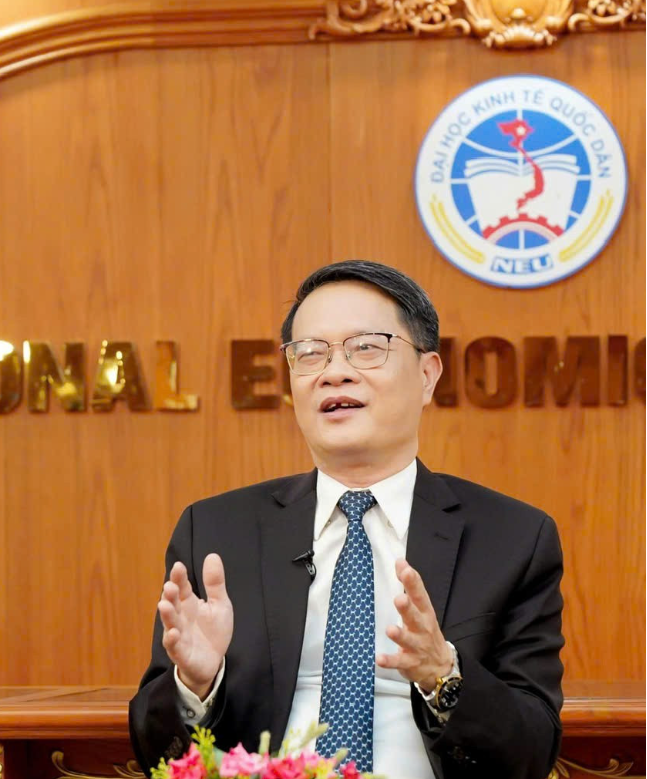
It is not only the first year of implementing Resolution 71 on breakthrough development in education and training, but also the year when several key legal frameworks take effect, including the 2025 Law on Higher Education (effective January 1, 2026), National Assembly Resolution 248, and upcoming guiding decrees from the Government.
This new policy framework is expected to create a more flexible legal environment, enabling higher education institutions to proactively innovate curricula, teaching methods, and resource allocation.
As one of the institutions actively implementing Resolution 71, the National Economics University has early introduced courses related to data science, digital technology, and AI applications, while gradually modernizing teaching methods through e-learning materials and AI-integrated digital resources.
In practice, AI enhances both student learning experiences and lecturers’ research efficiency. However, with tools like ChatGPT becoming increasingly accessible, academic integrity and AI overuse have emerged as major concerns—especially in economics-related fields where analytical and critical thinking skills are fundamental.
AI is an inevitable trend. Graduates will certainly use AI in their professional lives, just as educators and administrators do today. The key issue is not banning or restricting AI, but helping students understand what AI can and cannot do—and where human judgment and creativity remain irreplaceable.
AI may replace repetitive, routine tasks, but it cannot replace higher-order thinking, creativity, judgment, or decision-making in complex contexts. Therefore, the goal of higher education must go beyond knowledge transmission to cultivating critical thinking, problem-framing skills, and the ability to optimize technology use.
According to Phạm Thu Thủy, Vice Dean of the Faculty of Banking at Học viện Ngân hàng, accelerating digital transformation and AI adoption is a crucial solution to improving human resource quality, especially in key economic sectors.
In finance and banking—fields deeply connected to data analysis, forecasting, and risk management—AI adoption is no longer experimental but has become a comprehensive strategic approach.
The Faculty of Banking has added numerous technology- and AI-related modules, requiring students to directly apply digital tools to assignments instead of following the traditional “lecture–note-taking” model.
Lecturers now act as facilitators—posing problems, assigning tasks, and guiding students to find solutions independently. Students are encouraged to use AI to analyze and process information, then present, debate, and critically evaluate results. They must compare multiple sources, raise critical questions, and envision expected outcomes before using AI as support.
After two years of implementation, students have demonstrated faster access to knowledge, greater learning autonomy, and improved efficiency. However, these benefits are realized only when learners can define objectives clearly, ask the right questions, assess information reliability, and critically evaluate AI-generated outputs.
Assessment methods have also evolved. The Faculty evaluates AI usage as a skill, but requires students to demonstrate understanding, analysis, and the ability to transform knowledge into real-world problem-solving capacity. Strict assignment guidelines and AI-detection software are applied to prevent verbatim copying.
Ultimately, grades do not depend on whether students “use AI or not,” but on the depth of knowledge, problem-solving approach, and responsible, intelligent use of technology.
From real-world educational practice, it is clear that AI does not diminish the role of learners. On the contrary, it raises higher demands on critical thinking, resilience, and technological mastery. A correct approach will determine whether AI becomes a powerful driver of educational quality—or merely a shadow that obscures students’ true capabilities.
Source: “AI in Higher Education: Opportunities and Challenges” – Education & Times Online
 Post Category
Related articles
10.06.2026





 Admissions